
Shinto is often introduced in English as "the indigenous religion of Japan." That phrase is not wrong, but it is misleading on its own. Shinto does not have a single founder, a closed canon of scripture, or a doctrinal creed that adherents are asked to affirm. It is better described as a long, layered tradition of kami, shrines, rites, and places — practised, transmitted, and reshaped across the Japanese archipelago for well over a millennium. To ask "what is Shinto?" is therefore less like asking "what is Buddhism?" and more like asking "what is the way Japanese communities have related to the kami of their land and lineage?" The answer is not a definition; it is a set of recurring patterns.
This article is a working introduction. It does not try to settle the question of what Shinto is or to compress it into a single sentence. Instead, it sketches the elements that anyone reading further into Japanese religious history will encounter: kami as a category, the shrine as a relational space, rite and festival as the way the tradition is carried in time, and the major mythic and regional patterns through which Shinto becomes visible.
Kami Is Not a Translation of "God"
The first move that helps with Shinto is to slow down the English word "god." The Japanese term kami covers a much wider field. A kami can be an ancestral presence, a natural feature such as a mountain or river, a notable historical figure later enshrined, a force associated with rice and agriculture, a guardian of a region or craft, or a presence tied to a specific shrine. The classical phrase "the eight myriad kami" (yaoyorozu no kami) is meant to indicate not a literal count but an open, plural field.
Kami are encountered through relationships rather than through universal definitions. A kami has a name, a place where it is enshrined, narratives that gather around it, offerings that are appropriate to it, and rites by which it is approached. The connection between Amaterasu and the inner sanctuary at Ise, for instance, is not an abstract correspondence; it is sustained by ritual, geography, and an institutional memory that stretches across centuries. The same applies, in different registers, to local kami known mainly to a single village.
This is why early English-language descriptions of Shinto as "polytheistic" or "animistic" can be misleading. Those labels are not wrong as far as they go, but they tend to flatten the texture of the tradition. Kami are better understood as relational presences encountered in specific places, names, and times, not as a generic category of deities arranged in a pantheon.
The Shrine as a Relational Space
The visible centre of Shinto for most people is the shrine, in Japanese jinja. A shrine is not primarily a building dedicated to private prayer; it is a structured space in which a kami is enshrined and approached. The torii gate marks the threshold. The approach, the place for washing the hands and mouth, the inner precincts, and the main sanctuary together form a sequence by which a visitor moves from ordinary space toward the kami.
The architectural styles of shrines vary by region and tradition. Ise Jingu Naiku is associated with the Shinmei style and with a long history of periodic rebuilding. Izumo Taisha uses the older Taisha style and is tied to a different mythic centre, the cycle of the earthly kami. Fushimi Inari Taisha is known for its long sequences of vermilion torii and for the wide regional network of Inari shrines that look to it as a head sanctuary. These three together already suggest that the shrine tradition is not one uniform institution. It is a family of forms, each with its own enshrined kami, its own architectural conventions, and its own ritual rhythm.
Beyond the well-known examples, the Japanese archipelago contains tens of thousands of shrines of every scale, from small wayside fixtures to large complexes that anchor entire regional cults. The shrine is therefore one of the basic units in which the relationship between people, land, and kami becomes visible.
Rite, Matsuri, and the Calendar
Shinto is carried less by sermons and texts than by repeated rite. The Japanese word matsuri is often translated as "festival," but the underlying sense is closer to "the work of serving the kami." A matsuri usually has a fixed cycle within the year, a connection to a specific shrine and its enshrined kami, and a sequence of acts — purification, offering, music, procession, communal sharing — that together open and then close a ritual time.
Smaller individual acts share the same logic. The simple practice at a shrine entrance of rinsing the hands and mouth, the bow before the sanctuary, the clap, and the bow again are not symbolic gestures only; they are a compressed structure of approach. Even modern New Year visits to shrines, known as hatsumode, sit inside this same pattern of calendar-anchored attendance.
This emphasis on rite is part of what marks Shinto out as a tradition rather than a doctrinal religion. The continuity of Shinto is not measured by belief in a fixed text. It is measured by the repeated performance of rites at specific places, by the names of the kami that those rites address, and by the communities that maintain them.
The Kiki and Other Frames
Anyone reading about Shinto in English will quickly meet the two early eighth-century chronicles known collectively as the Kiki: the Kojiki of 712 and the Nihon Shoki of 720. They contain the major mythic narratives that later writers used to organise the world of the kami — the creation, the heavenly plain, the rock-cave episode, the descent from heaven, the cycle of Okuninushi and the transfer of the land, and the genealogical lines that connect mythic figures to early historical accounts.
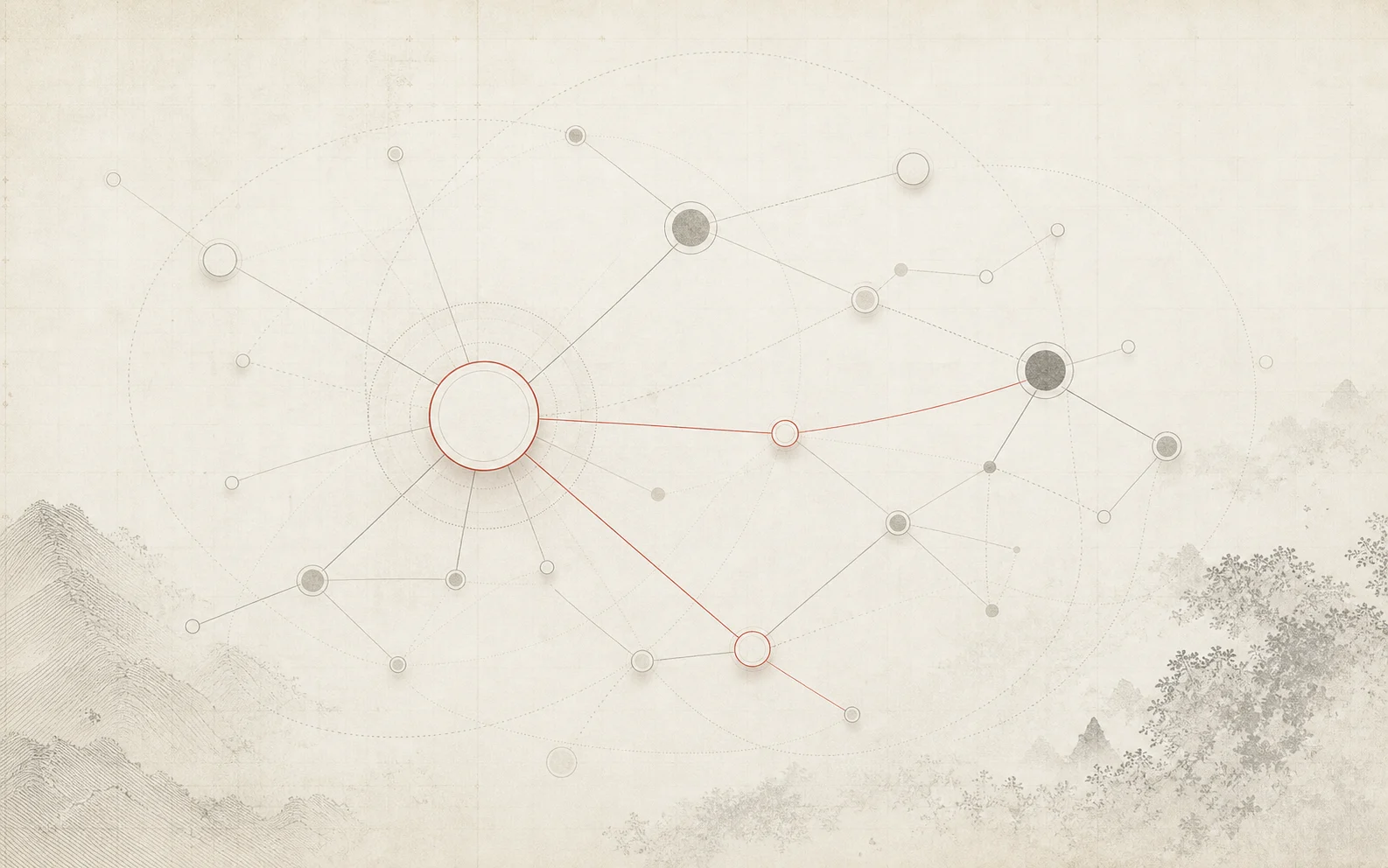
The Kiki are essential, but they are not the only frame. Local traditions known as fudoki, household and clan records, medieval shrine histories, Edo-period scholarship, and the long body of folkloric material gathered from the late nineteenth century onward all carry parts of the picture. Shinto seen only through the Kiki risks becoming a mythology of the centre. Shinto seen also through local sources becomes something more like a network: a centre with many regional weights, each of which can be approached on its own terms.
It is worth noting that the term "Shinto" itself shifts in meaning across history. In some periods it functions mainly to mark a distinction from Buddhism. In others it is used internally to name particular schools of thought, such as Yoshida or Ise traditions. The modern administrative category of "Shrine Shinto" (jinja shinto) reflects more recent reorganisation rather than an unchanged ancient identity. A careful reader holds this in mind when reading older English summaries.
Ise, Izumo, Inari: Different Patterns of Worship
A useful way to feel how plural Shinto is, without flattening it, is to compare three well-known shrine networks.
Ise Jingu Naiku enshrines Amaterasu and stands at the symbolic centre of the heavenly mythic line. Its rhythms are formal, its institutional memory deep, and its rites are tied to the rebuilding cycle and to the long association between the enshrined kami and broader ideas of order and continuity.
Izumo Taisha enshrines Okuninushi and stands at the centre of a different mythic line, that of the earthly kami and the land-transfer narratives. Izumo gathers a regional weight that the heavenly line alone does not capture; it is also associated with the annual gathering of kami in the tenth lunar month known as Kannazuki.
Fushimi Inari Taisha is the head shrine of the very wide network of Inari shrines associated with Inari, the kami of rice, household and agricultural prosperity, and, by extension, of many forms of livelihood. Inari worship spread through clan ties, trade, and local devotion. Its imagery — including the fox as a messenger — is more familiar internationally than the institutional history that produced it.
These three patterns — Ise as heavenly centre, Izumo as earthly counterpart, and Inari as widely diffused network — do not exhaust Shinto. They simply show that there is no single example one can hold up as the typical case.
What Shinto Is Not
It is also useful to say briefly what Shinto is not.
Shinto is not a doctrinal religion in the sense of a closed scripture and a creed. There is no central text whose acceptance defines membership. The Kojiki and Nihon Shoki are foundational sources, but they are read as classics and ritual reference works, not as a single revealed canon.
Shinto is not the same as Buddhism, which entered Japan in the sixth century and developed in long, complex co-presence with the kami tradition. For most of Japanese history, shrines and temples shared adjacent ground, and rites for kami and rites for buddhas were interwoven. The institutional separation of shrines and temples in the modern period was a deliberate reorganisation, not a recovery of an original split. Anyone reading older English material that presents Shinto as having stood alone for millennia should treat such accounts with care.
Shinto is also not a system of personal fortune-telling. The recommendation, oracle, and amulet practices found at shrines exist, but the heart of the tradition is the relationship between communities and the kami of their places and lineages, sustained by rite. Treating Shinto as a service for personal destiny narrows it almost beyond recognition.
Where to Read Next
For IZANORA, "what is Shinto?" is a starting question rather than a closing one. From here a reader can move toward the figures and sites that this article has only named: Amaterasu and the heavenly mythic line, Okuninushi and the earthly kami at Izumo, Inari and the wide network of rice and livelihood, and the shrines of Ise, Izumo, and Fushimi as different patterns of worship. Each entry opens further: to the local kami of a region, to the rites of a specific calendar, to the long historical conversations between shrine and temple, classic and commentary.
The article is not meant to define Shinto. It is meant to keep the question open in a way that makes further reading easier, and to mark the points at which a longer enquiry might continue.