
Folklore being
Azuki Arai
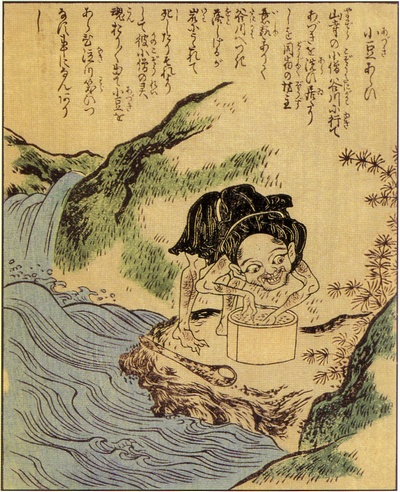
Azuki Arai is a phenomenon of strange sounds—the noise of beans being rinsed—heard at riverbanks, stream beds, and bridge approaches, primarily documented in Yamanashi Prefecture and across central and western Japan. Often described as a 'sound apparition' rather than a visible being, it is recorded in regional folklore and classical illustrated collections.
Description
Azuki Arai (bean-rinsing phenomenon) manifests as the sound of azuki beans being washed—described as 'grinding, crunching'—heard near rivers, streams, and bridge approaches. The entity typically remains unseen, announced only by its distinctive sound, making it a prominent example of a 'sound-based' strange phenomenon. Accounts span from Yamanashi and the Kōshinetsu region westward through central Japan and Kyushu, with regional variations depicting it as a young monk, a shaven-headed figure, or an elderly woman.
The phenomenon typically occurs at dusk and into the night. The conventional narrative has a listener stopping at a riverside or beneath a bridge to hear a chanting voice: 'Shall I take a person and eat them, or wash the beans?' When approached, the sound ceases and no figure appears—sometimes only scattered azuki beans remain on the water's surface or nearby stones. This pattern is documented extensively in upland settlements of Niigata and Gunma, southern Nagano, Wakasa in Fukui, Bitchu in Okayama, and northern Miyagi.
The phenomenon is illustrated in Toriyama Sekien's *Gazu Hyakkiyakō* (Picture Compendium of One Hundred Night Parade Demons, 1776) and also appears in *Ehon Hyaku Monogatari* (Illustrated Tales of One Hundred Stories). Folklorists including Yanagita Kunio (*Legends of Tōno: Supplement*), Sasaki Kizen (recording from Iwate and Miyagi), and Miyata Noboru (*Folkloristics of Yokai*) have compared related accounts. The National Institutes for the Humanities' 'Kaii and Yokai Folklore Database' systematically catalogues regional variant names.
Regional variants include the 'Azuki-grinding Old Woman' (Niigata and Sado), the 'Azuki-rinsing Young Monk' (Nagano), the 'Azuki-measuring' being (Miyagi and Fukushima), and the 'Rice-washing Woman' (Tokushima). Within the lineage of sound-based phenomena, related entities include 'Bet-bet-san' (a being marked only by footsteps) and the 'Laughing Fungus' (identified by its laughter).
Appears in legends
Sources
国際日本文化研究センター 怪異・妖怪伝承データベース
Primary source国際日本文化研究センター
小豆洗いに関わる怪異・伝承資料の参照入口。
https://www.nichibun.ac.jp/YoukaiDB3/小豆洗い - Wikipedia 日本語版
Secondary sourceWikipedia contributors
小豆洗いの概要に関する二次整理。
https://ja.wikipedia.org/wiki/%E5%B0%8F%E8%B1%86%E6%B4%97%E3%81%84
Sources
Read next
Your ties
Trace your own ties
Begin from what you have just read, and open the connections that are yours.
Trace your ties