
Folklore being
Hitotsume-kozo
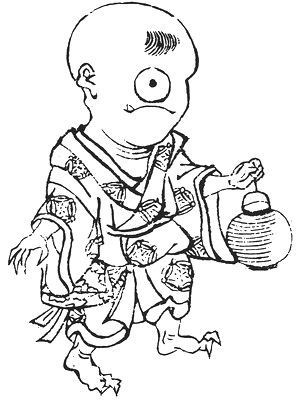
A one-eyed boy entity of the Kanto Koto-yoka folk calendar, organized in Yanagita Kunio's Hitotsume-kozo Sonota (1934).
Description
Hitotsume-kozo ("one-eyed boy") is a child-form entity with a single large eye on the forehead, shaved head, and a long tongue. The figure is closely tied to the Kanto folk calendar of Koto-yoka, the eighth day of the twelfth and second months, when Hitotsume-kozo visits homes to record misdeeds and bring illness. Households hang a high me-kago (eye-shaped basket) at the eaves; daunted by the many eyes, the entity withdraws. Distribution covers Musashi, Sagami, Kazusa, and Shimousa (modern Tokyo, Kanagawa, and Chiba), with related cases in Niigata and Fukushima. Yanagita Kunio's Hitotsume-kozo Sonota (1934) is the classic synthesis, linking the figure with the one-eyed smithing deity Ame-no-mahitotsu-no-kami of the Kogo Shui. Murakami Kenji's Nihon Yokai Daijiten (Kadokawa, 2005) and the International Research Center for Japanese Studies Yokai Folklore Database systematize the tradition.
Appears in legends
Sources
国際日本文化研究センター 怪異・妖怪伝承データベース
Primary source国際日本文化研究センター
一つ目小僧に関わる怪異・伝承資料の参照入口。
https://www.nichibun.ac.jp/YoukaiDB3/一つ目小僧 - Wikipedia 日本語版
Secondary sourceWikipedia contributors
一つ目小僧の概要に関する二次整理。
https://ja.wikipedia.org/wiki/%E4%B8%80%E3%81%A4%E7%9B%AE%E5%B0%8F%E5%83%A7
Sources
Read next
Your ties
Trace your own ties
Begin from what you have just read, and open the connections that are yours.
Trace your ties