
Folklore being
Shiranui
Shiranui is the strange flame-phenomenon seen offshore in the Yatsushiro and Ariake seas of western Kyushu, recorded as far back as the Nihon Shoki (720 CE).
Description
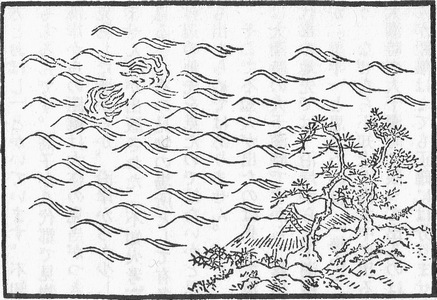
Shiranui is the strange flame-phenomenon of countless lights blinking in lines offshore in the Yatsushiro Sea (Shiranui Sea) and the Ariake Sea of western Kyushu on dark nights around the lunar new-moon of the seventh month. The phenomenon has been known since antiquity as "the fire that guided Emperor Keiko on his progress to Tsukushi," and is visible today from the coasts of Kumamoto, Fukuoka, and Saga. The Nihon Shoki (720 CE), Emperor Keiko year 18, fifth month, records that the emperor on his progress to Tsukushi saw a fire offshore in the country of Hi (Higo Province) and used it as a guide to land, naming the country Hi-no-Kuni; this is read as the earliest layer of the shiranui record. The principal viewing points are Misumi-cho, Uki, Yatsushiro, and Amakusa in Kumamoto, and the Ariake coast of Saga. From the early modern period the phenomenon is recorded as a parent-fire (oyabi) appearing first, with child-fires (kobi) lining up to either side. Optically the phenomenon is explained as refraction (a mirage) caused by the temperature difference between sea-surface and air. The Nihon Shoki (720 CE), Emperor Keiko Ki, and lost portions of the Higo no Kuni Fudoki record shiranui. The early-modern gazetteers Higo no Kuni-shi and Yatsushiro Gunshi systematize observation records; cultural-property treatment was once considered, and the Shiranui Observation Park in Misumi-cho, Uki, Kumamoto, is maintained. The Nichibunken Strange Phenomena and Yokai Folklore Database and Kumamoto and Yatsushiro local materials provide systematic compilation. Adjacent strange flames include kitsunebi, onibi, and hitodama, but shiranui is distinguished by its collective and lined appearance. Regional names include "bake-bi" (Shimabara peninsula) and "onibi" (Amakusa). The place-name Shiranui-machi (former Uki-gun, Kumamoto) and the "Shiranui-style" of yokozuna ring-entry, derived from the yokozuna Shiranui Komeemon, continue the name in cultural memory.
Appears in legends
Sources
国際日本文化研究センター 怪異・妖怪伝承データベース
Primary source国際日本文化研究センター
不知火に関わる怪異・伝承資料の参照入口。
https://www.nichibun.ac.jp/YoukaiDB3/不知火 - Wikipedia 日本語版
Secondary sourceWikipedia contributors
不知火の概要に関する二次整理。
https://ja.wikipedia.org/wiki/%E4%B8%8D%E7%9F%A5%E7%81%AB
Sources
Read next
Your ties
Trace your own ties
Begin from what you have just read, and open the connections that are yours.
Trace your ties