
Folklore being
Shuten-dōji
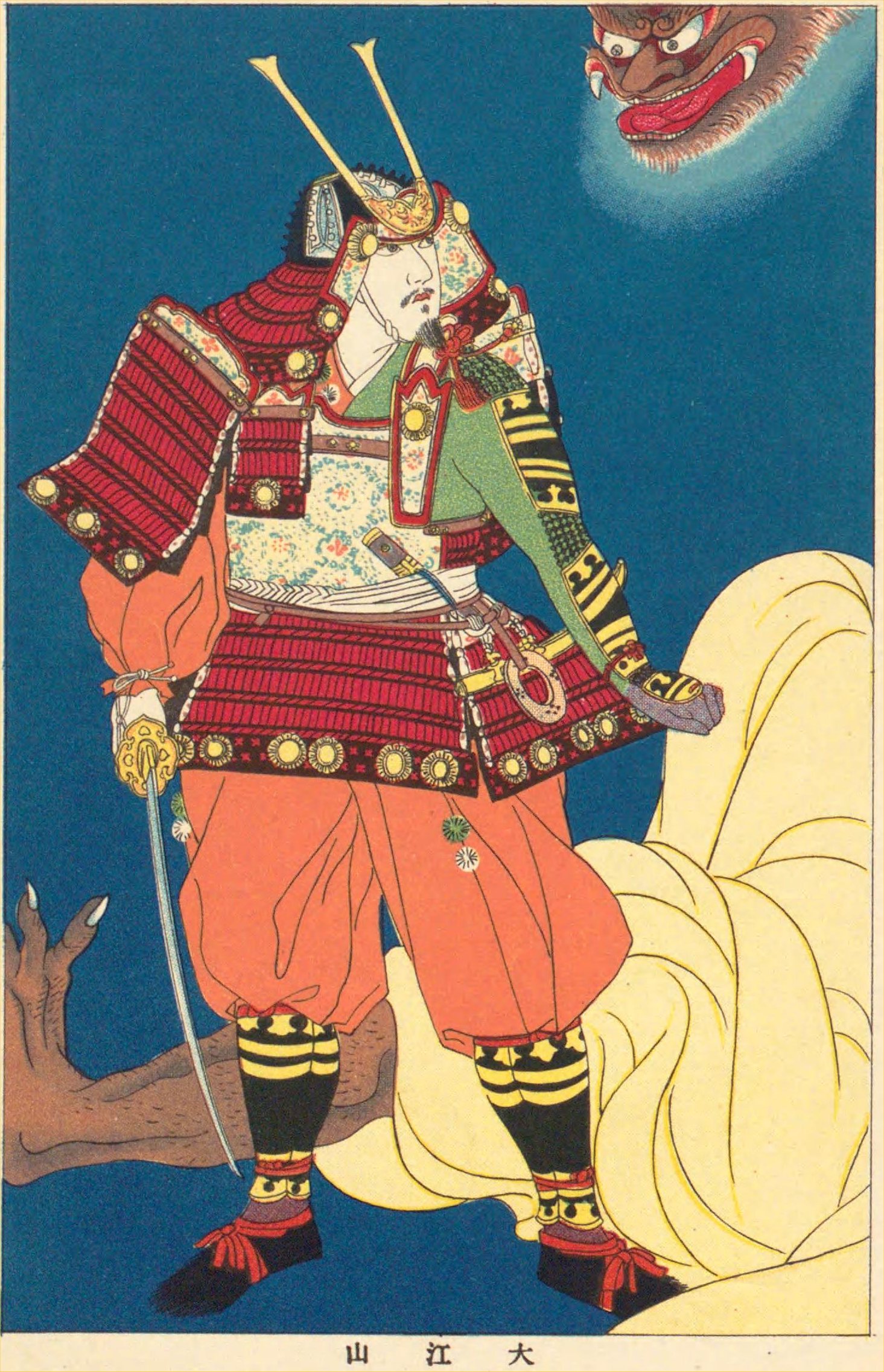
A demon leader said to dwell on Mount Ōe in Tanba Province, recorded in medieval folklore as having ravaged the imperial capital and abducted young women. The figure is chiefly known from accounts of his subjugation by Minamoto no Raikō and his four retainers.
Description
Shuten-dōji is described in medieval narratives as a demon chieftain who made his lair on Mount Ōe in what is now Fukuchiyama City and Yosa County in Kyoto Prefecture. According to tradition, he plagued the court during the reign of Emperor Ichijō (late 10th century), abducting young women until his subjugation by Minamoto no Raikō and the Four Heavenly Kings of Raikō—Watanabe no Tsuna, Sakata no Kintoki, Urabe no Suetake, and Usui no Sadamitsu. He is counted among Japan's three greatest demons, alongside Tamamo-no-Mae and Emperor Sutoku.
Accounts of Shuten-dōji's origins vary: some attribute him to Echigo or Mount Ibuki, and relate that after practising at Enryaku Temple he was expelled and established his stronghold on Mount Ōe. The canonical account describes Raikō's party disguising themselves as mountain ascetics and administering "divine-poison demon-slaying sake" to Shuten-dōji before beheading him. According to legend, even after decapitation his head bit Raikō's helmet. Probable locations associated with the narrative are the ruins of Oni-ga-jō in Ōe Town, Fukuchiyama, and the Mount Ōe range in Yosa.
Shuten-dōji figures prominently in texts spanning the medieval through early modern periods: the Muromachi-period narrative collection *Otogizōshi: Shuten-dōji*, the Noh play *Mount Ōe*, the picture scroll *Mount Ōe Picture Scroll* (14th century, Atsuji Museum), and early modern puppet theatre. Peripheral accounts of Raikō's demon subjugations appear in the *Konjaku Monogatari Shū* and *Kokon Chomonjū*. Modern scholarship, particularly Satake Akihiro's *Variant Accounts of Shuten-dōji* (1977), has systematically examined the tradition.
Shuten-dōji's subordinates include Ibaraki-dōji (said to have his arm severed by Watanabe no Tsuna at the Ichijō Modori Bridge), Hoshikuma-dōji, Torakuma-dōji, Kanakuma-dōji, and Kuma-dōji, forming a retinue paralleling Raikō's own. Origin narratives diverge considerably: the Echigo account locates him near Mount Yahiko; the Ibuki account makes him the child of the Ōmi Ibuki Myōjin; other versions invoke heterodox practices. Noh and *Otogizōshi* versions exhibit substantial variation.
Related sacred places
Appears in legends
Sources
御伽草子 酒呑童子
Primary source作者未詳
御伽草子系の酒呑童子譚。大江山の鬼退治筋を伝える古典資料。
https://dl.ndl.go.jp/酒呑童子 - Wikipedia 日本語版
Secondary sourceWikipedia contributors
酒呑童子伝承に関する二次整理。
https://ja.wikipedia.org/wiki/%E9%85%92%E5%91%91%E7%AB%A5%E5%AD%90
Sources
Read next
Your ties
Trace your own ties
Begin from what you have just read, and open the connections that are yours.
Trace your ties