
Folklore being
Tsuchigumo
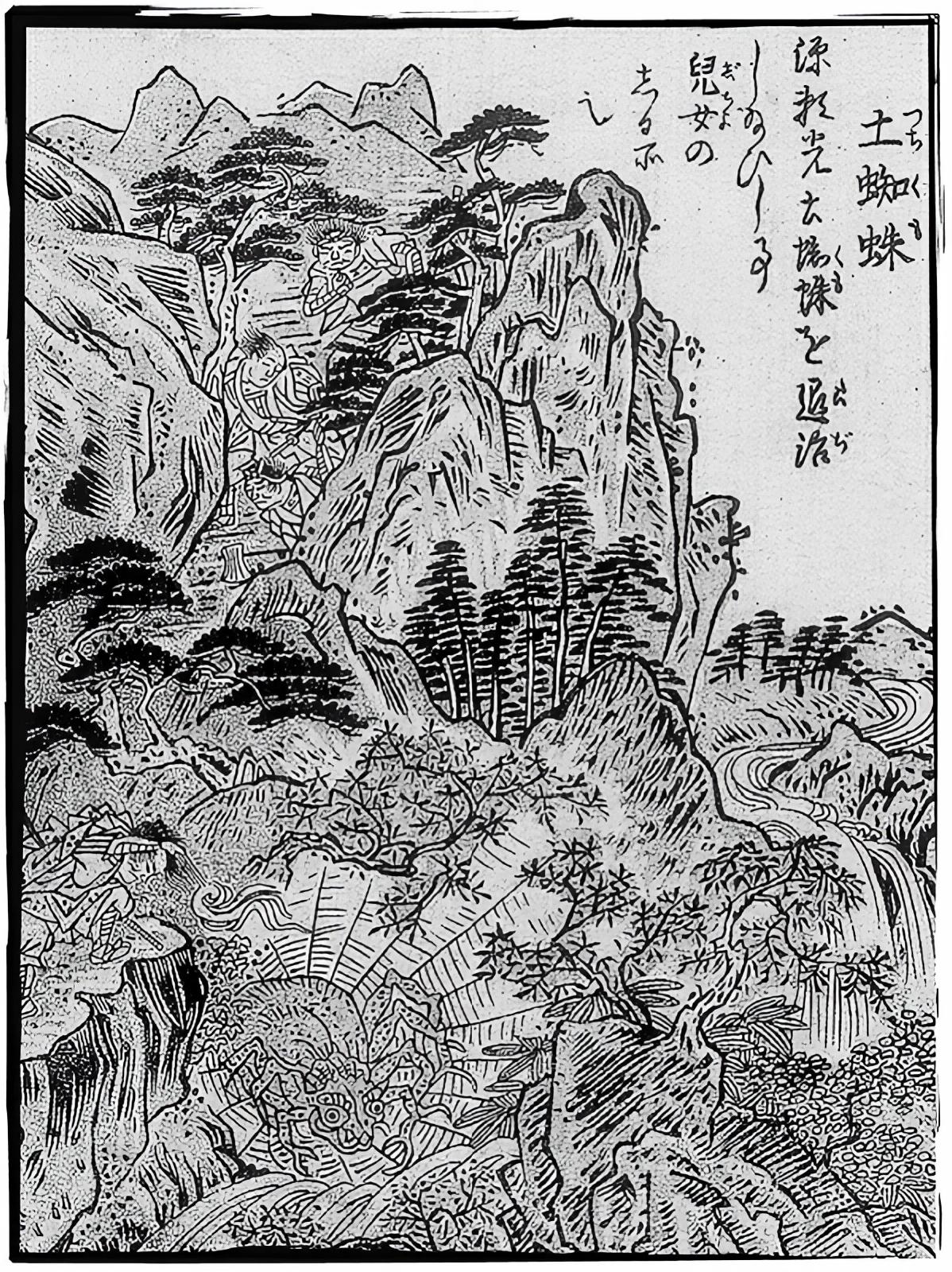
Tsuchigumo is a name in the Nihon Shoki (720 CE) and Fudoki for non-submitting indigenous groups, later told in the medieval period as a giant-spider yokai.
Description
Tsuchigumo is an ancient pejorative term for non-submitting indigenous populations and resistant groups, used in the Nihon Shoki (720 CE), the Bungo no Kuni Fudoki, the Hizen no Kuni Fudoki, and the Hitachi no Kuni Fudoki; from the medieval period onward, the name is also used for a giant-spider yokai. The earlier sources describe such groups as "having long arms and legs and dwelling in pits in the ground." The Nihon Shoki, Emperor Jimmu pre-accession scroll, records that at the Takaoharu village of Katsuragi (now Katsuragi, Nara) there were tsuchigumo, whom Jimmu put down. The same work, Keiko Tenno Ki, records tsuchigumo subjugations in Bungo and Hyuga; the Bungo no Kuni Fudoki preserves traditions of tsuchigumo in Ono and Naoiri counties; the Hizen, Hitachi, and other Fudoki carry related traditions. As yokai, the medieval picture-scroll Tsuchigumo Soshi (late Kamakura-Nanboku-cho) shows Minamoto-no-Yorimitsu attacked on his sickbed by a giant spider and striking it down with the sword "Hizamaru"; the scene is set in Rendaino in Murasakino, Kita-ku, Kyoto. Sources include the ancient tsuchigumo records of the Nihon Shoki's Jimmu, Keiko, and Saimei reigns, as well as the Bungo, Hitachi, and Hizen Fudoki. The Tsuchigumo Soshi (Tokyo National Museum collection) and the Noh play Tsuchigumo (attributed to Kanze Motomasa) consolidate the yokai-form image, and the kabuki Tsuchigumo carries the tradition into the present. The Nichibunken Strange Phenomena and Yokai Folklore Database registers the ancient and yokai records side by side. Adjacent transmissions: at Shobon-Rendaiji in Kita-ku, Kyoto, a "Yorimitsu-Asomi Tsuka" tsuchigumo mound remains; tsuchigumo traditions are recorded across western Japan, including Takaoharu in Katsuragi (Nara), the Matsuura region of Hizen (Saga, Nagasaki), and Naoiri in Bungo (Oita). Adjacent yokai of enlarged insects and beasts include jorogumo and ushi-oni.
Related sacred places
Appears in legends
Sources
日本書紀 土蜘蛛記事
Primary source舎人親王ら(撰)
日本書紀に見える土蜘蛛記事。土蜘蛛表象の一次資料。
土蜘蛛 - Wikipedia 日本語版
Secondary sourceWikipedia contributors
土蜘蛛伝承に関する二次整理。
https://ja.wikipedia.org/wiki/%E5%9C%9F%E8%9C%98%E8%9B%9B
Sources
Read next
Your ties
Trace your own ties
Begin from what you have just read, and open the connections that are yours.
Trace your ties