
Folklore being
Yuki-Onna
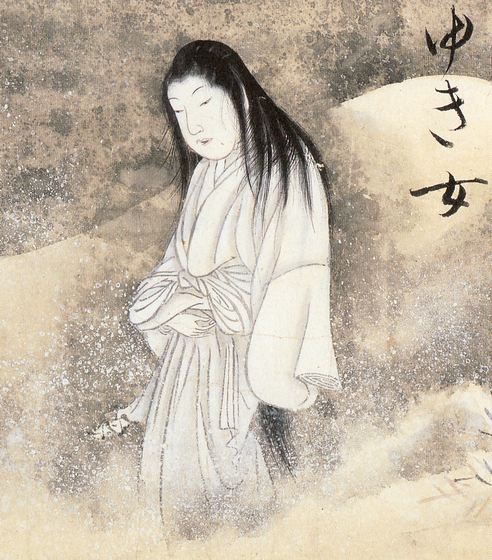
The yuki-onna is a female *kaii* (strange phenomenon) that appears on snowy nights in mountains, passes, and villages, primarily documented in Niigata and other snow regions of northern Japan. Depicted with white clothing, long black hair, pale skin, and the ability to freeze or steal a person's breath, she is said to freeze travelers to death or spare them on condition of silence.
Description
The yuki-onna is a female apparition that manifests on snowy nights in mountain huts, mountain passes, and village edges across snow country—particularly Niigata, Tōhoku, and the Hokuriku region. She is characterised by white garments, long black hair, pale complexion, and the power to freeze human breath or steal it away, causing death. Her apparent age varies by region: she may appear as a young girl, a young woman, or an elderly crone.
She typically emerges during blizzards to encounter lost hunters and travellers, either freezing them to death or sparing their lives in exchange for a prohibition—they must never speak of the encounter to anyone. Lafcadio Hearn's *Kwaidan* (1904) records the account of woodcutters Shigezaku and Minokichi from Tama County, Musashi Province, in which Minokichi's wife, O-Yuki, later discovers his secret. Similar tales circulate across Nagano's Otani region, Niigata's Uonuma district, and Aomori's Shimokita Peninsula.
Medieval linked-verse manuscripts such as the *Sōgi Shokoku Monogatari* (late 15th century) record an encounter with such a being in Echigo Province. From the early modern period onwards, accounts and illustrations appear in collections like the *Ehon Hyakumonogatari* and *Kokon Hyakumonogatari Hyōban*. Yanagita Kunio's *Legends of Tōno: Supplement* (*Tono Monogatari Shūi*) preserves examples from Tōhoku traditions.
Regional variants carry distinct names: "yuki-jorō" in Aomori, "yuki-banba" (snow crone) in Yamagata, "yuki-bito" (snow person) or "yuki-bōzu" in Iwate, and "yuki-musume" (snow daughter) in Wakayama. Related *kaii* include the "icicle woman" and "snow priest." Some regions describe male or child forms. The National Institutes for the Humanities' *Database of Kaii and Yokai Lore* systematically catalogues these regional variants and distributions across Japan.
Appears in legends
Sources
国際日本文化研究センター 怪異・妖怪伝承データベース
Primary source国際日本文化研究センター
雪女に関わる怪異・伝承資料の参照入口。
https://www.nichibun.ac.jp/YoukaiDB3/雪女 - Wikipedia 日本語版
Secondary sourceWikipedia contributors
雪女の概要に関する二次整理。
https://ja.wikipedia.org/wiki/%E9%9B%AA%E5%A5%B3
Sources
Read next
Your ties
Trace your own ties
Begin from what you have just read, and open the connections that are yours.
Trace your ties