
Amaterasu-Omikami is one of the central kami of Japanese myth. In English she is often introduced as the sun goddess, but that phrase only gives the first layer. In the Kojiki and Nihon Shoki, Amaterasu stands at the meeting point of light, ritual order, heavenly authority, and the genealogies that later connect myth to the imperial line. She is not simply a figure who represents the sun. She is a node through which heaven, earth, kinship, shrine worship, and political memory are arranged.
To understand who Amaterasu is, it helps to begin with her birth. The Kojiki places her after Izanagi-no-mikoto returns from the land of Yomi and purifies himself. From the washing of his left eye, Amaterasu comes into being. From his right eye comes Tsukuyomi-no-mikoto, and from his nose comes Susanoo-no-mikoto. This triad matters because Amaterasu is not isolated. Her identity is formed through a set of siblings who mark different domains and different forms of disorder, distance, and return.
Izanagi gives Amaterasu the High Plain of Heaven, Takamanohara, to rule. The scene frames her as a heavenly ruler, but the myth does not present rule as simple command. Her authority is tested almost immediately through Susanoo, whose turbulent conduct in heaven disrupts weaving, agriculture, and ritual space. These are not random acts in the story. They strike the very practices through which order is made visible: fields, halls, cloth, offerings, and the shared work of the kami.
What the Name Points To
The name Amaterasu is usually explained from a phrase meaning "shining in heaven" or "illuminating heaven." Omikami is an honorific form that marks her as a great kami. English introductions often translate the whole name as "the great sun goddess," which is useful as a first approximation. Still, "kami" should not be treated as a simple equivalent of the English word "god." In Shinto contexts, kami may be ancestral, natural, place-based, ritual, or narrative presences. They are understood through relationships, names, sites, offerings, and stories rather than through a single universal definition.
That matters for Amaterasu because her identity is not limited to a function. She illuminates, but she also rules. She withdraws, but she also returns through ritual. She is a sister to Susanoo and Tsukuyomi, a descendant of Izanagi, an ancestor in the heavenly genealogy, and the enshrined kami of Ise. Each relationship adds a different layer. When a reader asks "who is Amaterasu?", the answer is therefore not just "a sun goddess." A better answer is: Amaterasu is the great kami of heavenly radiance whose myths organize kinship, authority, ritual restoration, and the descent from heaven to earth.
This layered reading also keeps the article from turning Japanese myth into a list of character profiles. The classics do not introduce Amaterasu as a detached symbol. They show how a name, a body of narratives, a ritual object, and a shrine tradition come to hold one another in place.
The Rock-Cave Episode
The best-known Amaterasu myth is the rock-cave episode, often called Amano-Iwato. After Susanoo's violence in Takamanohara, Amaterasu withdraws into a cave and closes it behind her. The world becomes dark. The kami gather, consult, prepare a mirror and jewels, and stage a rite outside the cave. Ame-no-Uzume dances, the gathered kami laugh, and Amaterasu opens the door enough to look out. At that moment she is drawn back into the world.
This episode is often summarized as the disappearance and return of the sun. That is true, but the structure is more precise. The world is restored not by force alone, but by ritual coordination: counsel, objects, performance, sound, and timing. The mirror is especially important because it allows Amaterasu to encounter her own radiance as something placed before her. In later tradition, the mirror becomes inseparable from her worship and from the regalia connected with the heavenly descent.
The cave episode also shows why Amaterasu should not be read only as a nature figure. Her light is cosmic, but the story is about social and ritual repair. When she withdraws, the loss is not merely physical darkness. The shared order of the kami loses its center. When she returns, the world is not just bright again. A pattern of ritual action has been established.
From Heaven to Earth
Amaterasu's role continues through the myths of descent. In the heavenly line, her descendants are sent toward the Central Land of Reed Plains, the human world as framed by the mythic geography of the classics. The story first passes through negotiations with the earthly kami, especially Okuninushi-no-kami, who is associated with the ordering of the land and with Izumo. The handover of the land is not a simple conquest narrative. It is a negotiated transfer in which different divine lineages are given distinct places in the emerging order.
The descent itself is carried by Ninigi-no-mikoto, Amaterasu's grandson. He is sent down with sacred objects, including the mirror associated with Amaterasu. On the way, Sarutahiko-no-kami appears as a guide at the threshold between heaven and earth. This moment is crucial for understanding Amaterasu's position. Her presence moves from direct heavenly rule into objects, instructions, descent, and shrine worship. The mythic line does not leave her behind in heaven; it carries her into the geography of Japan through ritual transmission.
This is also why Amaterasu is central to the idea of kami as relational beings. She is connected backward to Izanagi, sideways to Tsukuyomi and Susanoo, downward to Ninigi, and outward to the earthly kami of Izumo and the guiding presence of Sarutahiko. Her importance comes from this network as much as from any single title.
Amaterasu and Ise Jingu
Today Amaterasu is most closely associated with Ise Jingu, especially the Inner Shrine, Naiku. The shrine's official tradition centers on Amaterasu-Omikami as the enshrined kami of Naiku, and the mirror is treated as part of that long ritual continuity. For many readers outside Japan, Ise is the point at which a mythic figure becomes a living shrine tradition. The connection is not just symbolic. It is maintained through repeated rites, shrine rebuilding, offerings, and institutional memory.
The Ise tradition also helps clarify a common misunderstanding. Amaterasu is not a free-floating "solar deity" detached from practice. She is encountered through a specific ritual and historical setting. Her myths explain why light, mirror, descent, and order matter; the shrine tradition gives those themes a place and a rhythm. Ise Jingu therefore acts as a bridge between classical narrative and continuing worship.
Another useful comparison is Inari-Okami. Inari is also widely known outside specialist circles, but through a different pattern: shrines, fox imagery, rice, commerce, and regional spread. Amaterasu's prominence is narrower in imagery but deeper in the architecture of mythic authority. Placing them side by side shows that "kami" is not one uniform category. Some kami are known through local cults and repeated petitions; others, like Amaterasu, stand at the structural center of a mythic and ritual order.
What Amaterasu Means in Japanese Myth
The meaning of Amaterasu is therefore layered. At the first level, she is associated with the sun and with illumination. At the second, she is the ruler of Takamanohara, whose withdrawal and return mark the fragility and restoration of order. At the third, she is the ancestor figure whose line leads toward the descent of Ninigi. At the fourth, she is the kami enshrined at Ise, where myth is carried into ritual time.
These layers should be kept together. If Amaterasu is reduced to "the Japanese sun goddess," her role becomes too thin. If she is treated only as an ancestor of the imperial line, the cave episode and Ise worship lose their wider ritual texture. If she is described only as an object of shrine worship, the mythic network that explains her position fades from view.
The more careful reading is this: Amaterasu is the kami through whom brightness, kinship, order, and ritual continuity are joined. Her story begins in purification, passes through withdrawal and return, extends through heavenly descent, and settles into the long memory of Ise. That is why she remains an essential entry point for anyone asking who Amaterasu is, what she means, or how Japanese myth connects the world of the kami to the geography of shrines.
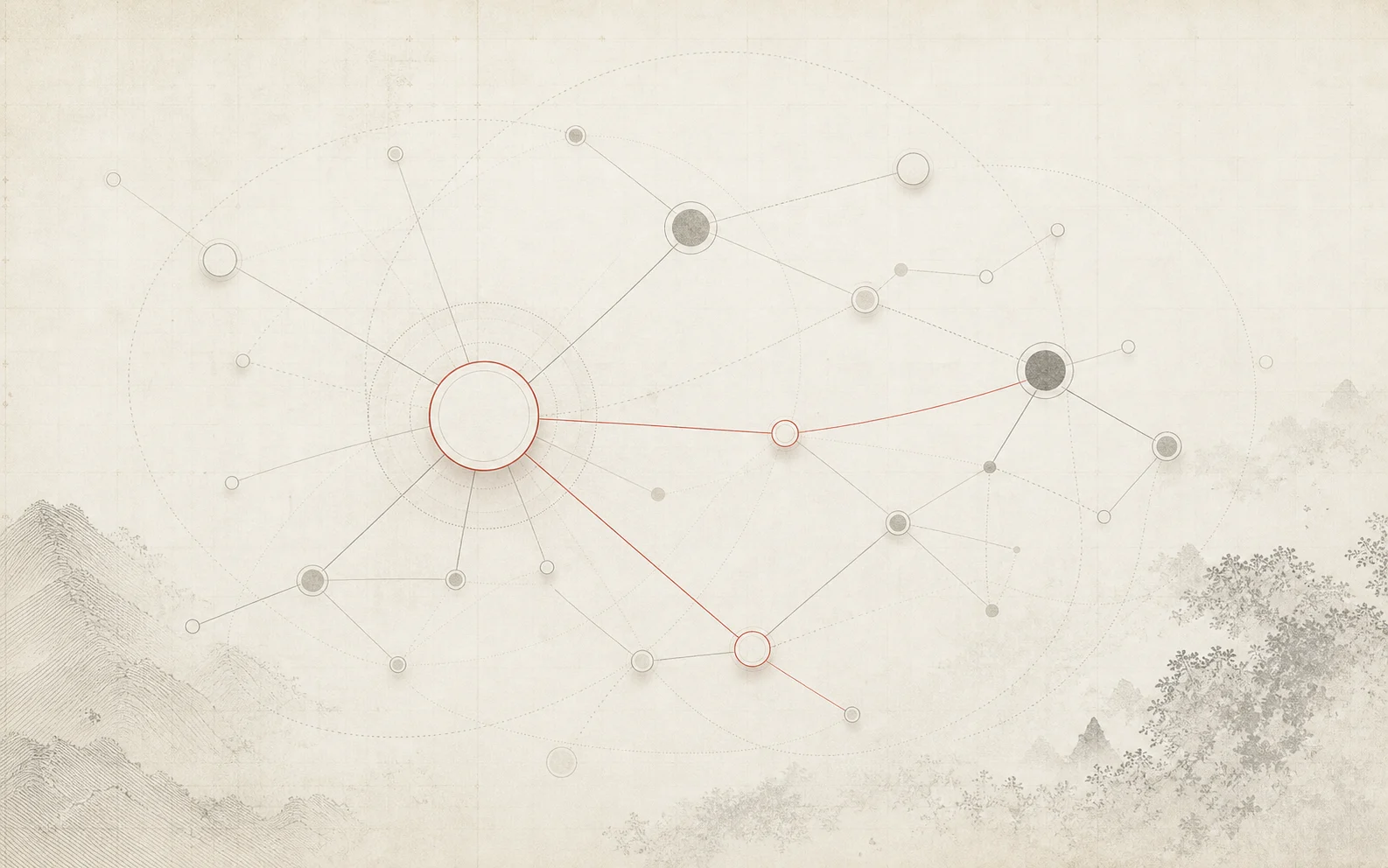
For IZANORA, Amaterasu also functions as a strong starting node in the public graph. From her, a reader can move to Izanagi and the birth of the major kami, to Susanoo and the rock-cave crisis, to Tsukuyomi and the celestial sibling pattern, to Okuninushi and the land-transfer narratives, to Ninigi and the descent, and to Sarutahiko as the guide at the threshold. The article is not meant to close the question of Amaterasu. It is meant to open the paths that gather around her.