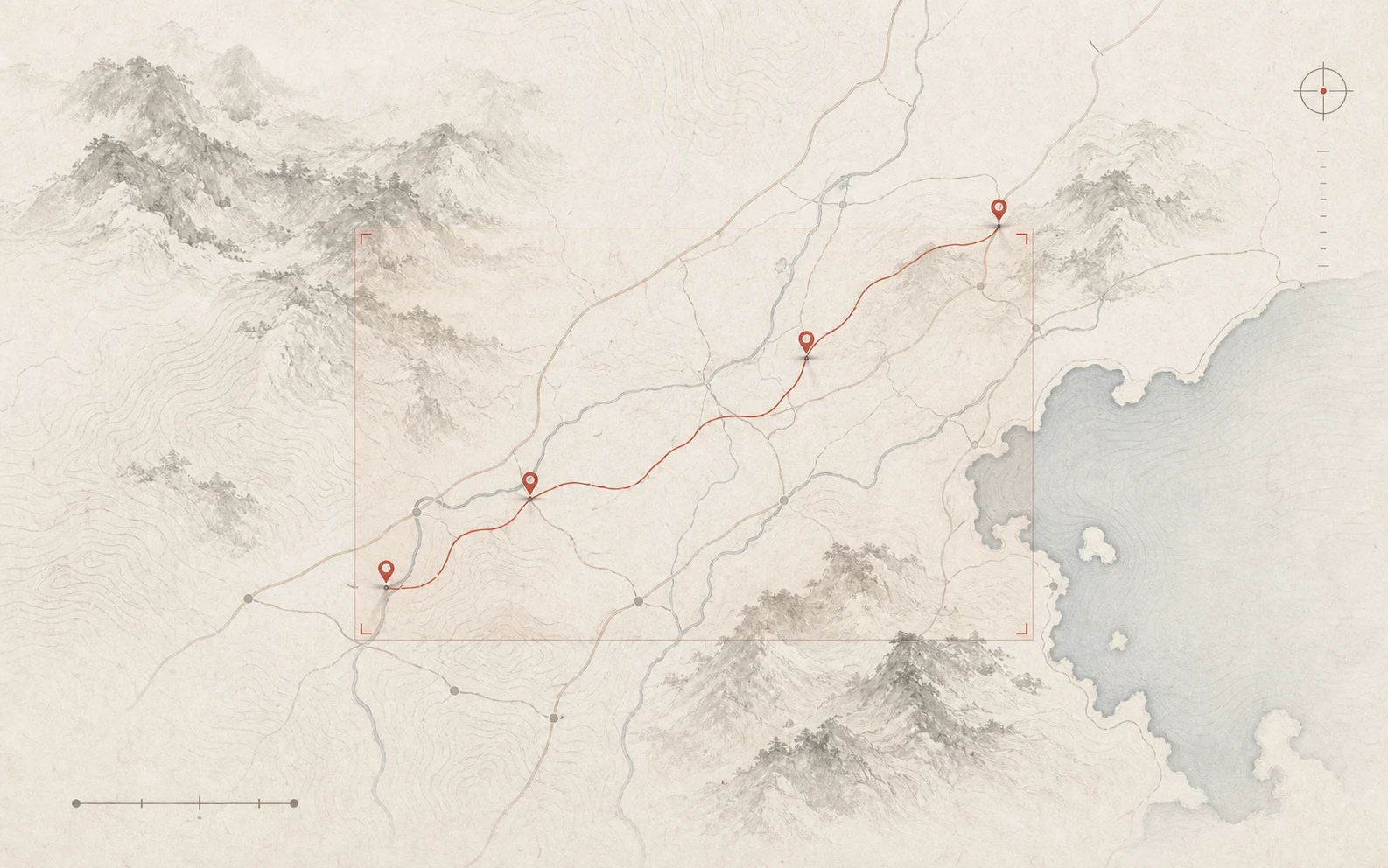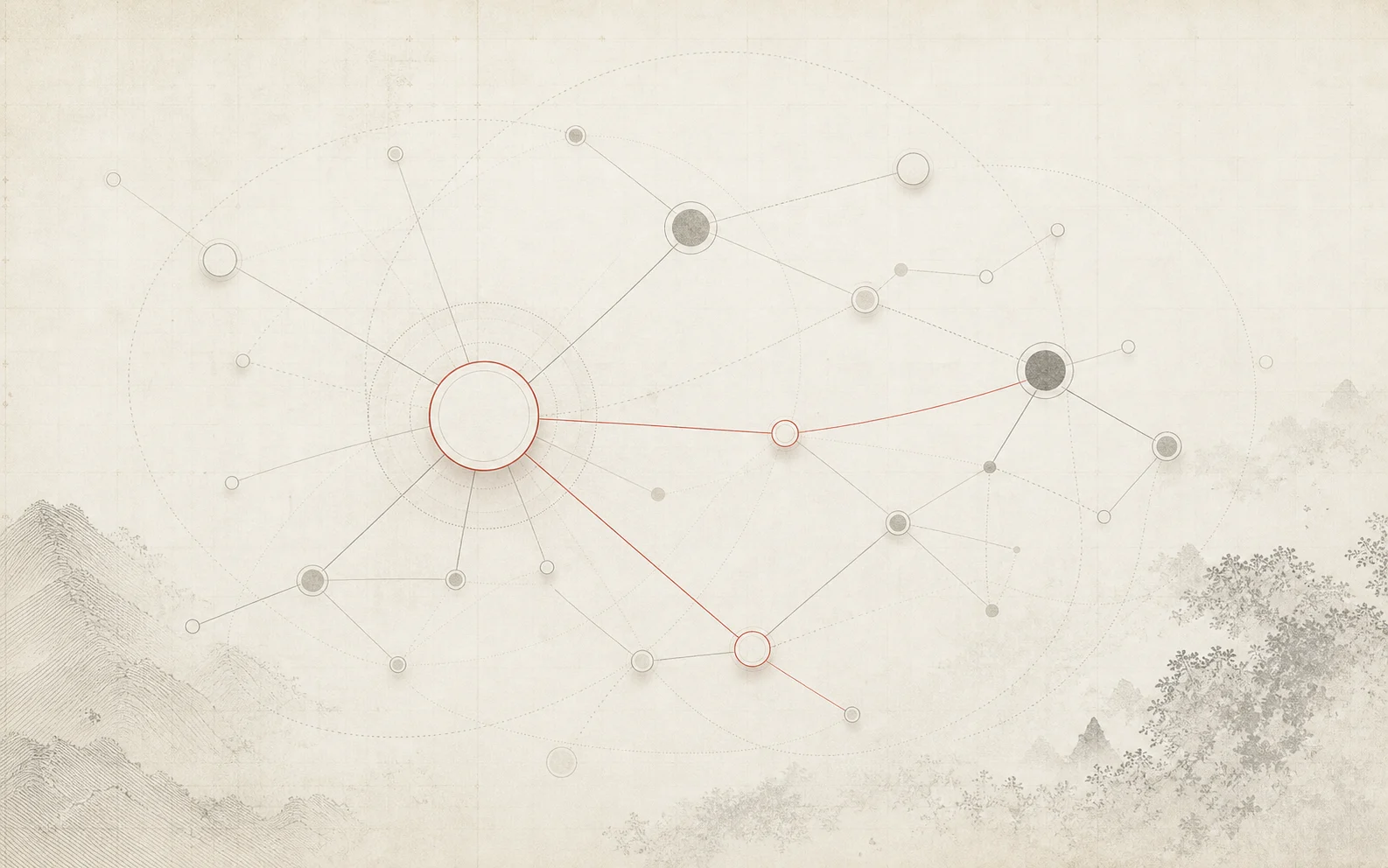

English-language introductions to Japanese religion often begin with a list of "Japanese gods." The phrase is convenient, but it sets up the wrong expectations. In the Kojiki and Nihon Shoki, the figures we usually translate as gods are called kami, and the world of the kami is not organized as a closed set with fixed roles. A kami can be an ancestral presence, a feature of the landscape, a ritual object, a force named in a story, or a figure enshrined at a particular place. The point is not the catalogue. The point is the network of relationships through which each kami is known.
This guide introduces the major kami most often asked about in English: the parent generation, the heavenly siblings, the line that connects to Izumo, the descent toward the human world, and two more kami who show how widely the word "kami" can stretch. Read it as a map of relations, not as a roster.
Why "God" is Only a Rough Translation
The English word "god" carries assumptions that do not transfer cleanly. It often implies a single fixed identity, an attribute or domain, and a hierarchy that runs from highest to lowest. The Japanese term kami works differently. In the Kiki tradition, a kami is recognised through names, narratives, ritual sites, and the relationships that hold those together. A kami may be enshrined in many places, named in several variant forms, and connected to other kami by birth, oath, descent, or shared episode. There is no single attribute that defines what a kami is.
This is why English-language guides should treat "the gods of Japan" as a working phrase rather than a settled list. In the Kiki tradition, the major kami are read through their position in stories and shrines, not through a chart of domains. When we ask "who is this kami?", the most precise answer is usually a set of relations: who they were born from, who they stand alongside, who descends from them, and where they are enshrined.
Izanagi, Izanami, and the Cycle of Creation
A useful place to begin is with Izanagi-no-mikoto and Izanami-no-mikoto. In the Kojiki, this pair stands at the threshold of the named world. They are tasked with shaping the land, descend from the heavenly bridge, and bring forth the islands of Japan and a long series of kami associated with sea, river, mountain, wind, and food. Their story is not a single act of creation. It is a sequence in which the world becomes nameable.
The cycle also includes its rupture. Izanami dies after giving birth to a fire kami, and Izanagi follows her into the land of Yomi. He fails to bring her back, and the separation between the world of the living and the realm of the dead becomes part of the cosmic order. When he returns and purifies himself, the next generation of central kami appears. Izanagi and Izanami should therefore be read together, not as a couple with fixed traits, but as the pair through whom the world's geography, generations, and limits are first articulated.
The Heavenly Siblings: Amaterasu, Tsukuyomi, Susanoo
From Izanagi's purification come three of the most widely known kami. Amaterasu-Omikami is born from the washing of his left eye, Tsukuyomi-no-mikoto from his right eye, and Susanoo-no-mikoto from his nose. They are usually summarised as sun, moon, and storm. That gloss is useful as a first sketch, but it leaves out what the texts are actually doing. The three siblings are introduced together because they mark different domains of order and disorder, and their story is about how those domains relate.
Amaterasu is given Takamanohara, the High Plain of Heaven. Tsukuyomi is given the night. Susanoo, set toward the seas, refuses his task and rises to heaven, where his conduct provokes the famous rock-cave episode. The cave story is not just about the loss of sunlight. It is about the collapse and restoration of shared ritual space, and it is resolved through counsel, performance, mirror, and laughter rather than by force. Read this way, the sibling triad is less a set of three personified forces and more a structure in which heavenly order is tested and repaired.
Okuninushi and the Line of Izumo
Okuninushi-no-kami belongs to a different layer. The Izumo cycle, which the Kojiki gives at length, follows a kami who is at first one of many brothers and is gradually shaped — through trial, ordeal, and counsel — into the figure who orders the Central Land of Reed Plains. Okuninushi is associated with the cultivation of the land, with healing, and with the long ritual life of Izumo Taisha.
His role is essential because it shows that the heavenly line is not the whole of the mythic world. There is a sustained earthly tradition with its own kami, its own pacts, and its own shrine memory. The eventual handover of the land — usually rendered in English as the "transfer of the land" — is a negotiation between heavenly messengers and the Izumo line, not a conquest. Okuninushi steps back from political authority and is honoured through enshrinement. The narrative leaves both lineages present, with different responsibilities, instead of collapsing one into the other.
Ninigi and the Descent from Heaven
The bridge between heaven and earth is carried by Ninigi-no-mikoto, Amaterasu's grandson. He is sent down with sacred objects, including the mirror associated with Amaterasu, and arrives at a peak in Hyuga. The descent is often introduced under the term tenson korin in Japanese scholarship. In the Kiki tradition, it marks the moment when the heavenly line moves into the geography of Japan, and the imperial-line layer of the classics begins.
A common mistake in English summaries is to read this descent as the founding of a single ruling pantheon. The texts are more careful. The descent specifies objects, instructions, and intermediaries; it threads through earlier negotiations with Okuninushi; and it leaves the earthly kami in place. Ninigi is therefore less a king-figure than a node where the heavenly narrative becomes tied to particular places, particular shrines, and a particular continuing line.
Inari: A Different Pattern of Worship
Not every major kami sits inside the Kiki descent. Inari-Okami is one of the most widely worshipped kami in Japan, with shrines across the country and a long association with rice, grain, commerce, and household fortune. Inari is encountered less through a single famous episode and more through repeated, distributed worship: small shrines, fox-form messengers, votive offerings, and a rich regional vocabulary.
Including Inari in a guide to the major kami matters because it widens the picture. If a reader meets only the Kiki figures, they may assume that "the major kami" are those who appear in the heavenly narrative. In shrine practice, the most encountered kami are not always the most narrated. Inari shows that prominence can come from breadth of worship and embedded daily ritual, not just from position in the classical texts.
Sarutahiko: Kami of the Threshold
Sarutahiko-no-kami appears at a hinge moment. When Ninigi descends, a tall and luminous kami stands at the crossroads where the heavenly path meets the earthly road. That kami is Sarutahiko, and he becomes the guide. In English summaries he is often labelled a "road god," which is too narrow. Sarutahiko is the kami of the threshold itself — the point at which one order yields to another and a passage is opened.
For a guide to the major kami, Sarutahiko is useful because he names something the other figures only imply. The mythic geography is full of edges: between heaven and earth, between the living and the dead, between heavenly and earthly lineages, between shrine precinct and outer world. The kami who is encountered at those edges is not a minor figure. He shows that the world of the kami is structured by transitions, and that transitions need their own enshrined presence.
Reading the Kami as a Network
Set side by side, these kami do not form a closed pantheon. Izanagi and Izanami stand at the threshold of the nameable world. Amaterasu, Tsukuyomi, and Susanoo mark the testing and repair of heavenly order. Okuninushi holds the earthly line and the long memory of Izumo. Ninigi carries the descent into the geography of Japan. Inari shows worship spreading beyond the Kiki texts. Sarutahiko names the threshold itself.
The right way to read these names is therefore through relation, not domain. Amaterasu is the sister of Susanoo and Tsukuyomi, the descendant of Izanagi, the ancestor of Ninigi, and the kami enshrined at Ise. Okuninushi is the figure with whom the heavenly line negotiates and who is honoured at Izumo. Inari is encountered through a different kind of presence — distributed, agricultural, household. Each name in this guide can be expanded into its own article, its own shrine map, and its own set of variant texts.
For IZANORA, this is exactly the point. The kami are best entered as a network of named nodes, each of which opens further paths. From Amaterasu, a reader can move into the rock-cave episode and Ise Jingu. From Okuninushi, into the Izumo cycle and the land-transfer narratives. From Ninigi, into tenson korin and the regalia. From Inari, into shrine geography and household practice. From Sarutahiko, into the question of thresholds and the kami who guard them. This guide is not the last word on the major kami of Japanese myth. It is meant to open the doors.