
The word "yokai" (妖怪) is one of the most widely circulated terms from Japanese folklore, and also one of the easiest to misread. In English it often arrives as "Japanese monsters," "spirits of the night," or a generic label for anything strange in a woodblock print. Each of those framings carries the term further from how it actually works in the sources. Yokai is better read as an umbrella term for named figures and incidents that index something about a specific place, season, threshold, or social anxiety. It is closer to a way of paying attention than to a single category of being.
The Japanese term most often paired with yokai in academic writing is "kaii" (怪異), which can be translated as strange happening or anomalous incident. Where yokai tends to point at the figure — a kappa by the river, a tengu on the mountain — kaii points at the event: the strange sound, the missing traveller, the unaccountable light at the edge of the field. The two words overlap, and many writers use them together. For a careful reading of folklore, it helps to hold both: yokai names something that has been noticed, and kaii is the act of noticing it.
Yokai and Kami Are Not the Same Thing
A common confusion is to treat yokai and kami as opposite ends of a single spectrum, with kami as good and yokai as bad. The classics do not work that way. Kami are presences enshrined and venerated: they have names recorded in the Kojiki and Nihon Shoki, shrine seats, festival calendars, and lineages of priests. They are addressed through offering, ritual, and the long memory of a community. Yokai are not enshrined in the same sense. They are encountered, told about, warded against, and sometimes pacified through small rites; but the relationship is closer to neighbourhood and rumour than to formal worship.
The line between the two is porous. A figure can begin as a feared local presence and, over centuries, be enshrined and become a kami of place. A kami can be remembered as wild and dangerous when its rites have lapsed. The pair therefore should not be treated as two species but as two modes of attention to the same field of presences. Kami are the ones whose names a community keeps inside ritual time; yokai are the ones whose names a community keeps inside story time, on the road, or at the edge of the village.
Yokai Are Place-Bound
One of the clearest patterns in Japanese folklore is that yokai are placed. They are not free-floating monsters. They sit at specific elements of landscape, and each landscape feature carries its own set of figures.
The kappa belongs to the river, the pond, and the irrigation ditch. The kappa is not a demon. It is a water figure whose stories track the very real hazards of water — drowning, kidnapping of livestock, drinking from the wrong well — and the agricultural anxieties around the dish-shaped depression at the top of its head, which holds the water of its power. Children growing up near rivers were given kappa stories not as horror but as a memorisable form of caution.
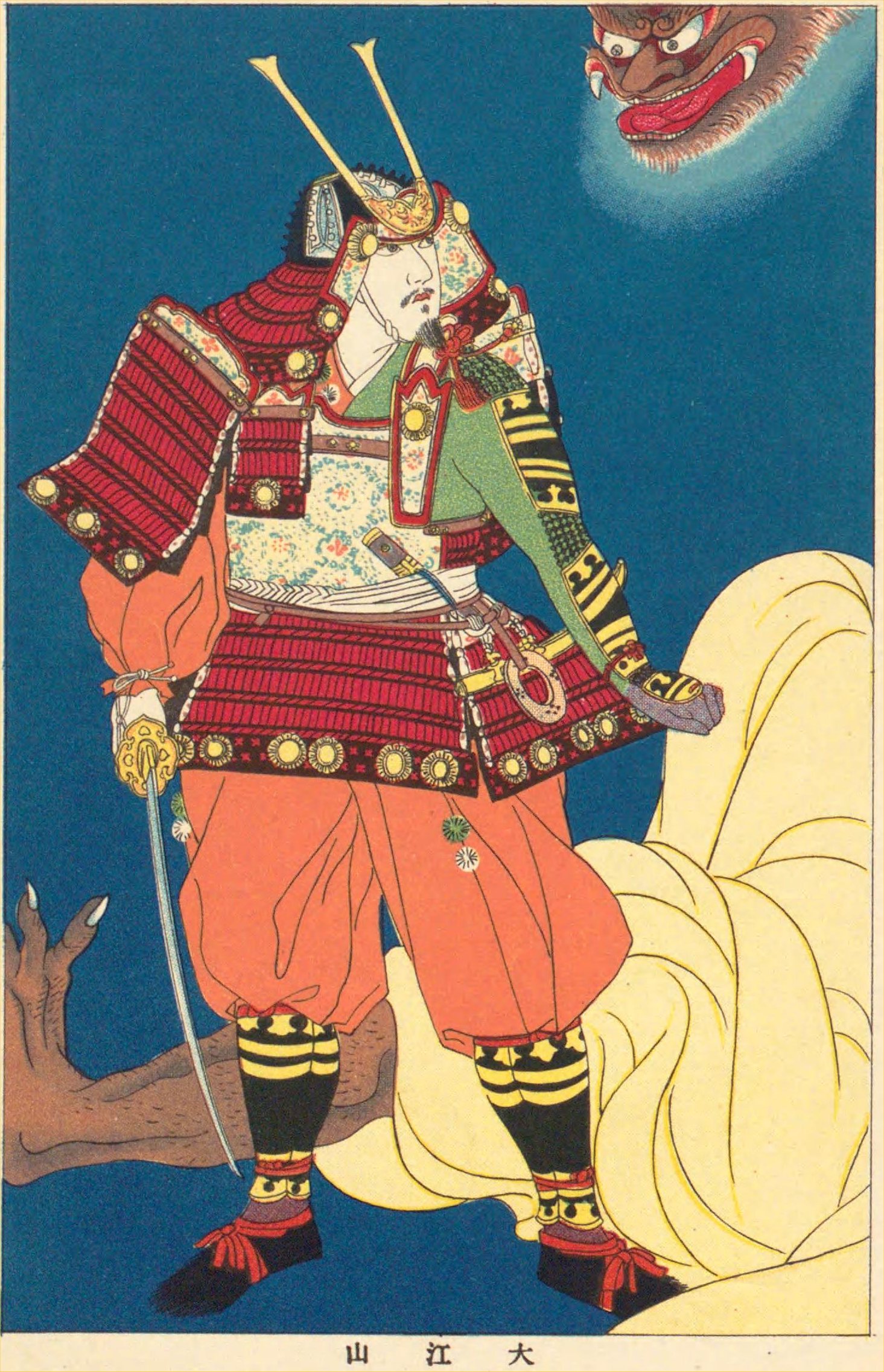
Mountains carry their own set. The tengu, of which the Kurama tengu is the most widely cited example, gathers around remote peaks, deep forests, and the routes of ascetic practice. Tengu are not simply mountain monsters; they sit alongside the practices of yamabushi and the long association of high places with discipline, training, and the testing of pride. A tengu encounter in story is often an encounter with one's own arrogance reflected back through the figure of someone who has stayed too long on the mountain.
At the boundary between human settlement and the wild — the shrine fence, the rice-field edge, the dusk road — the fox figures appear. Foxes in Japanese folklore are layered. There is the fox as messenger of Inari at the threshold of the shrine; the fox as bewildering presence on the country road; the kudagitsune of household-level possession traditions; and the high literary figure of Tamamo-no-Mae, the courtly woman later revealed in story as a nine-tailed fox. These are not interchangeable. They name different kinds of encounter with the same animal at different social registers: shrine, road, household, court.
Rooms, ridges, and old objects also carry figures: the yamauba in the deep mountain hut, Shuten-doji in the Heian-era cycle of mountain oni and capital-bound retainers, and tsukumogami figures around tools that have grown old. In each case the location is not background to the figure; the location is what the figure is for.
Yokai Are Season-Bound and Threshold-Bound
A second pattern is that yokai gather around boundaries in time as well as space. Dusk is a yokai hour. The fold between late summer and autumn is a yokai season. The end of the old year, when households cleared accounts and waited for renewal, drew its own set of figures. The yuki-onna is not simply a winter ghost; she is a figure of the moment when snow makes the familiar road unfamiliar.
Threshold spaces — bridges, crossroads, gates, the porch of an empty house — are likewise productive of figures. The hitotsume-kozo tradition that gathers in parts of eastern Japan around February sits at exactly this point: a calendrical edge, a household threshold, and a small rite of warding involving baskets and protective gestures. The figure is inseparable from the date and the doorway. To strip it of either and present it as a generic creature is to lose the structure of the tradition.
A useful rule of thumb when reading yokai stories is to ask, before anything else, where and when. Most of the meaning is held in those two answers.
The Edo-Period Encyclopedias and the Idea of a Yokai Catalogue
A great deal of what circulates internationally as "Japanese yokai" passes through the Edo-period illustrated encyclopedias of Toriyama Sekien (1712 to 1788), whose Gazu Hyakki Yagyo and its sequels gave many figures their now-canonical visual form. Sekien drew on earlier picture scrolls and on a long oral and local repertoire, and he also coined or recombined figures of his own. His work matters for two reasons.
First, the encyclopedias took a body of local, place-bound traditions and arranged them as a sequence of named images — a kind of catalogue that could be carried, copied, and quoted. The visual stabilisation of yokai we now take for granted owes a great deal to this Edo-period editorial moment, not to a single ancient origin.
Second, Sekien's catalogues sit beside, and feed into, later popular print culture and modern study. The folklorist Yanagita Kunio in the early twentieth century and, in our own time, the work associated with Komatsu Kazuhiko and the Nichibunken folklore database, treat the encyclopedias as one set of sources among many — alongside village notebooks, regional gazetteers, and the long catalogue of kaii in older classical literature such as the Konjaku Monogatari collection. For a careful reader of Japanese folklore today, Sekien is a turning point but not the origin: the figures he illustrated are mostly older and rooted in places that were never primarily about the print.
Yokai in Living Tradition
Yokai are not only a printed past. They continue in shrine festivals, regional storytelling, and tourism keyed to particular figures. The Namahage rite of Oga in Akita, in which masked figures visit households at the year's turn, is one of the better-known cases where a figure popularly grouped with yokai is in fact a continuing community rite registered by UNESCO. Kappa appear today on signs warning children at riverbanks, in town mascots, in shrine festivals along specific waterways. Tengu remain present at certain mountain shrines and in masked roles at festivals along the routes of mountain practice.
Reading these continuities, the careful question is again about specificity. The kappa on a Tokyo souvenir is not the same as the kappa whose story a grandmother told a child by a particular river in Iwate; both share a name and a set of features, but the second one is the one that does the cultural work the tradition originally asked of the figure.
How to Read a Yokai
It helps to read yokai relationally rather than spectacularly. For any figure, four questions tend to recover most of the meaning. Where is it placed — which river, which mountain, which doorway, which season? Which sources name it — village notebook, classical anthology, Edo encyclopedia, modern compilation? What does it index about the community that kept its name alive — water risk, mountain practice, courtly anxiety about disguise, household care of old tools? And how does it sit beside the kami of the same area, since the two often share landscape and the boundary between them shifts over time?
Read this way, a yokai is not a creature on a list. It is a small piece of evidence about how a particular place and time noticed something at its edges and gave it a name that other people could pass on.
For IZANORA, yokai entries are entry points into the same kind of relational reading. From a single figure a reader can move outward to the rivers and ranges in which the figure was first told, the legends and capital-bound retainer narratives in which it later appears, the shrines and temples that share its territory, and the kami whose rites occupy the same landscape. The aim is not to settle what a yokai is, but to keep the question open in a way that further reading and walking can continue.