
When English-speaking readers ask about sacred places in Japan, the question usually arrives through a short list: Ise, Izumo, Fushimi Inari, sometimes Itsukushima or a Kumano image of forested steps. Each of those names points to a real place, but the list format hides what makes them sacred. In the Japanese tradition, a sacred place is not a category of scenery. It is a site held in relation to a named kami, a ritual cycle, a surrounding landscape, and often a wider network of related shrines. To read these places well, it helps to begin with the distinctions that the language itself preserves.
The first distinction is between a Shinto shrine and a Buddhist temple. In English the two are easily blurred under words like "ancient temple" or "spiritual site," but the Japanese terms are clear. A jinja, jingu, or taisha is a Shinto institution where one or more kami are enshrined. A tera or ji (as in Todai-ji or Kongobu-ji on Koyasan) is a Buddhist temple. The two traditions have lived next to one another for centuries and sometimes share a single mountain, but their rites, clergy, architecture, and primary objects of devotion are different. A reader who learns to look for a torii at the threshold, a honden as the inner sanctuary, and a clear enshrined kami listed at the entrance will already read most shrines correctly.
What Makes a Place Sacred
In Shinto, sacredness is signalled rather than declared. A shimenawa, the heavy braided rope, marks a tree, a rock, a waterfall, or a shrine gate as belonging to the world of the kami. A pair of stone komainu guards the approach. The sando, the path leading inward, is itself part of the rite: visitors walk it, pause at the temizuya to rinse hands and mouth, and proceed to the haiden, the hall of worship. Behind the haiden stands the honden, where the kami is enshrined. Many honden are deliberately small and closed, because the kami's presence is not meant to be displayed.
The site also matters. Mountain shrines, water shrines, and rock shrines exist because particular features of the landscape are read as places where the kami can be encountered. Omiwa Jinja in Nara is one of the clearest examples: the mountain itself, Mt. Miwa, is the object of worship, and the shrine has no honden behind the haiden because the body of the kami is the mountain. This is the older pattern of Shinto practice, in which the place precedes the building.
The names also carry weight. Jinja is the general term for a shrine. Jingu marks a shrine of imperial connection or particular dignity. Taisha, "great shrine," is reserved for a small number of sites with deep ritual importance. These titles are not decorative; they signal a place's standing within the wider network of shrines.
Ise and the Pattern of Continuous Renewal
Ise Jingu Naiku, the Inner Shrine of Ise, enshrines Amaterasu-Omikami and is treated, in the modern shrine system, as the central shrine of the imperial line. For many readers Ise is the first sacred place in Japan to name, but the most important feature of Ise is not its age in the simple sense. It is the shikinen sengu, the rebuilding tradition in which the main sanctuaries are reconstructed on adjacent ground at fixed intervals, with their sacred objects ritually transferred to the new buildings. Ise is therefore not an ancient site in the sense of stone ruins. It is a site of long ritual continuity, where continuous remaking is the point.
The same logic governs how Ise should be read in English. The shrine is not a monument to a distant past. It is a working institution whose rites, offerings, priestly lines, and rebuilding schedule are carried forward in the present. Naiku enshrines Amaterasu-Omikami. The outer shrine, Geku, enshrines Toyouke-Omikami, the kami associated with food and sustenance for Amaterasu. Together they form a single ritual complex, not two separate attractions.
Izumo and the Land-Side Counterpart
Where Ise stands for the heavenly mythic line, Izumo Taisha stands for the land-side. The enshrined kami is Okuninushi-no-kami, the great kami associated with the ordering of the land and with the negotiated transfer of the country narrated in the Kojiki and Nihon Shoki. Izumo is a taisha, a great shrine, and its honden is one of the tallest and oldest-styled shrine buildings in Japan. The architecture itself, in the taisha-zukuri style, is older than the shinmei-zukuri style associated with Ise.
Izumo's ritual calendar carries a striking national pattern. The tenth month of the old lunar calendar is called Kannazuki, "the month without kami," across most of Japan, because the kami are understood to gather at Izumo for an annual assembly. In Izumo itself the same month is called Kamiarizuki, "the month with kami." This is one of the clearest examples of how a single place sits inside a larger sacred geography, rather than standing alone.
Reading Ise and Izumo together is more accurate than reading them in isolation. The classical myths set them as two poles of a single order: the heavenly line through Amaterasu and her descendants, and the earthly line through Okuninushi and the kami of the land. The shrine system carries that pairing forward.
Fushimi Inari and the Wider Inari Pattern
Fushimi Inari Taisha in Kyoto enshrines Inari-Okami and is the head shrine of an Inari network that spreads across the country. The torii-lined paths climbing Inari-yama are the image most often used to introduce Japan visually in English-language media, but Fushimi Inari is best understood as a head node in a wider pattern. Inari shrines stand at the edges of fields, in city neighbourhoods, on rooftops, beside factories, and in mountain hollows. They are tied to rice, to commerce, to safe passage, to local petitions, and to the fox imagery that often guards their gates.
Reading Fushimi Inari this way changes how a visit is framed. The site is not a single photogenic complex but the centre of a long radial geography. Every small Inari shrine in another part of Japan is in some sense connected to it through the shared kami and the shared form of practice. The path up the mountain, with its thousands of vermilion torii donated over generations, is itself a record of that distributed devotion.
Atsuta Jingu in Nagoya offers a different model. It is closely connected to the sacred sword tradition of the imperial regalia and shows how a shrine can carry a specific object-centred lineage. Kasuga Taisha in Nara holds the long ritual line of the Fujiwara clan and is closely tied to the deer of the Kasuga grove. Each of these shrines is shaped by its own kami, clan history, and locale, which is why a single template will not describe them all.
Pilgrimage as Network
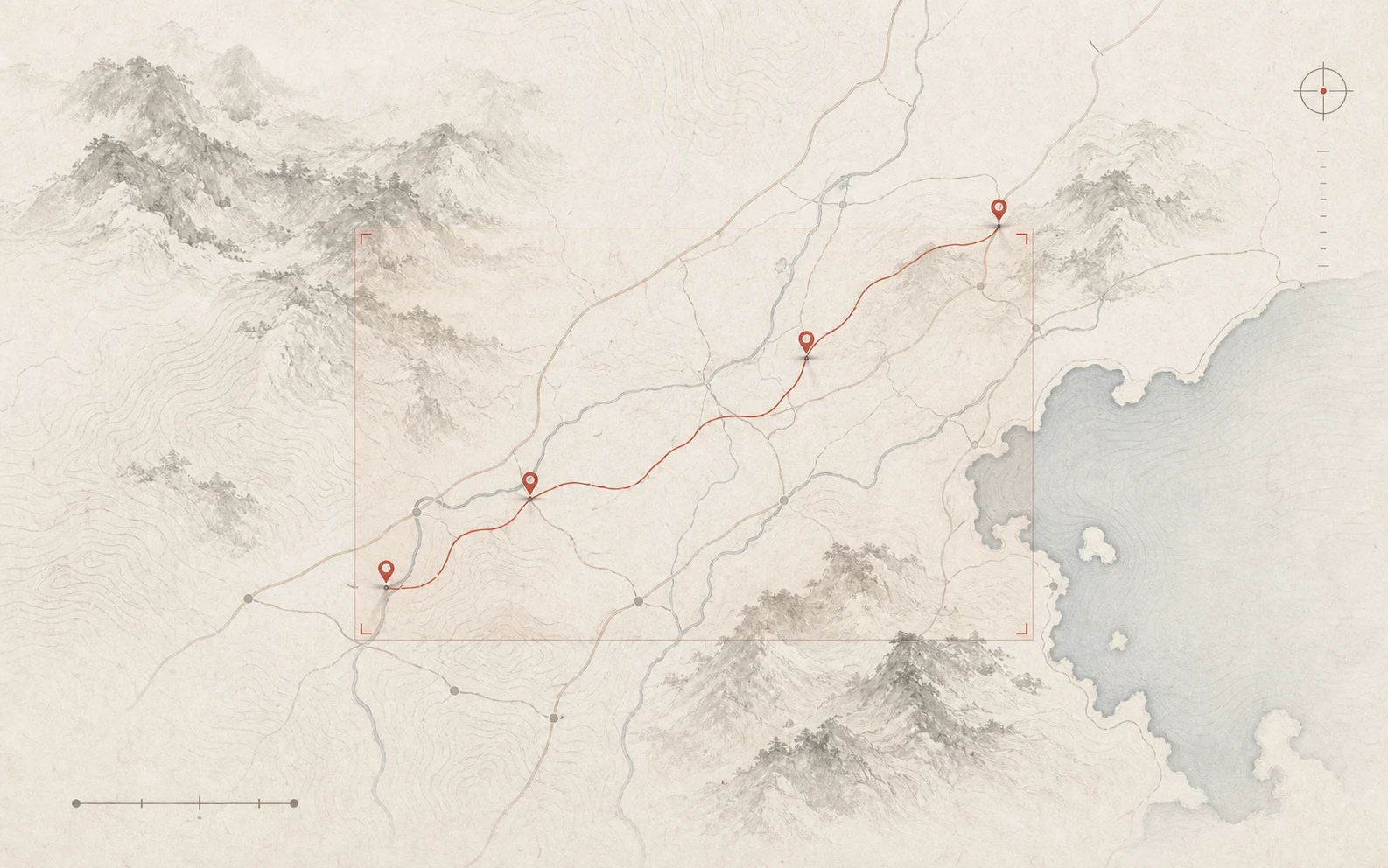
Sacred geography in Japan also runs as routes, not only as points. The Kumano region in the Kii peninsula holds three grand shrines, the Kumano Sanzan: Kumano Hongu Taisha, Kumano Nachi Taisha, and Kumano Hayatama Taisha. They are linked by the old Kumano pilgrimage paths through the forested mountains. Pilgrims have walked these routes for over a thousand years, in part because the three shrines together hold a wider field of the kami than any one of them could alone.
The Shikoku Henro is a different kind of network. It is a Buddhist pilgrimage circuit of eighty-eight temples around the island of Shikoku, associated with Kukai. The path Iyo Henro Kanjizai-ji Michi preserves part of this old walking infrastructure. Mentioning Shikoku Henro here is a useful contrast: it is a temple pilgrimage rather than a shrine pilgrimage, but the underlying idea of holiness as a route through landscape is shared. Mountain centres such as Koyasan, the Buddhist monastic complex established by Kukai, sit in this same family of network-shaped sacred geographies.
This is why "top sacred places in Japan" is the wrong frame. Many of the most important sites are not best understood one at a time. They are nodes in routes, mountains, and clan lines.
Reading a Shrine Compound
Almost every Shinto shrine, from a small neighbourhood jinja to a great taisha, follows a recognisable spatial order. A torii marks the boundary between the everyday world and the world of the kami. The sando, often gravel, leads inward. The temizuya provides water for purification. The haiden, the hall of worship, is where visitors offer coins, bow, clap, and pray. The honden behind it holds the kami. At larger shrines there may also be sessha and massha, smaller auxiliary shrines that house related kami within the same precinct.
Once this layout is familiar, places that first looked similar begin to read as distinct. Meiji Jingu in Tokyo, surrounded by a planted forest, encloses an entirely different atmosphere from Heian Jingu in Kyoto, with its bright Heian-style courtyards. Both follow the same underlying shrine grammar, yet each carries a different historical layer.
Sacred Places as a Living Network
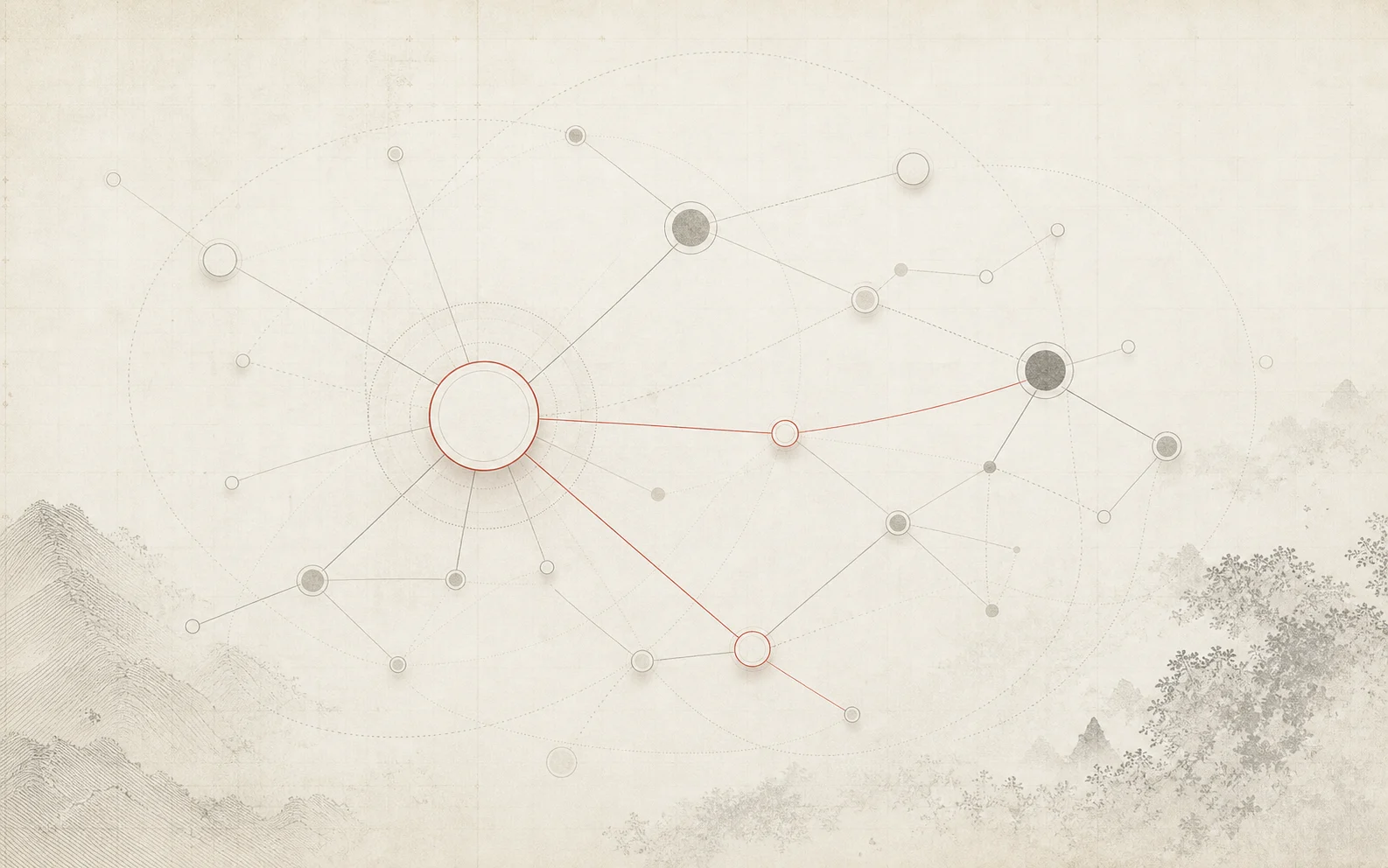
For IZANORA, sacred places in Japan are best read as a network rather than a ranking. Ise and Izumo set the heaven and land poles of the classical mythic order. Fushimi Inari opens onto the distributed Inari devotion across the country. Kasuga, Atsuta, and Meiji each carry their own clan, object, or modern history. The Kumano shrines and the Henro path show that sacred geography runs as routes through landscape as well as points on a map. And the brief contrast between jinja and tera helps a reader hold the Shinto pattern steady against neighbouring Buddhist traditions like Koyasan rather than blurring them together.
The article does not aim to close the question of where the sacred lives in Japan. It aims to open the paths that connect these places: from Ise to Amaterasu, from Izumo to Okuninushi, from Fushimi Inari to the wider Inari pattern, from Kumano to pilgrimage as a form, and from any one shrine to its surrounding landscape, ritual calendar, and clan history. A reader who follows even one of those threads will find that a single place quickly opens onto several others.